

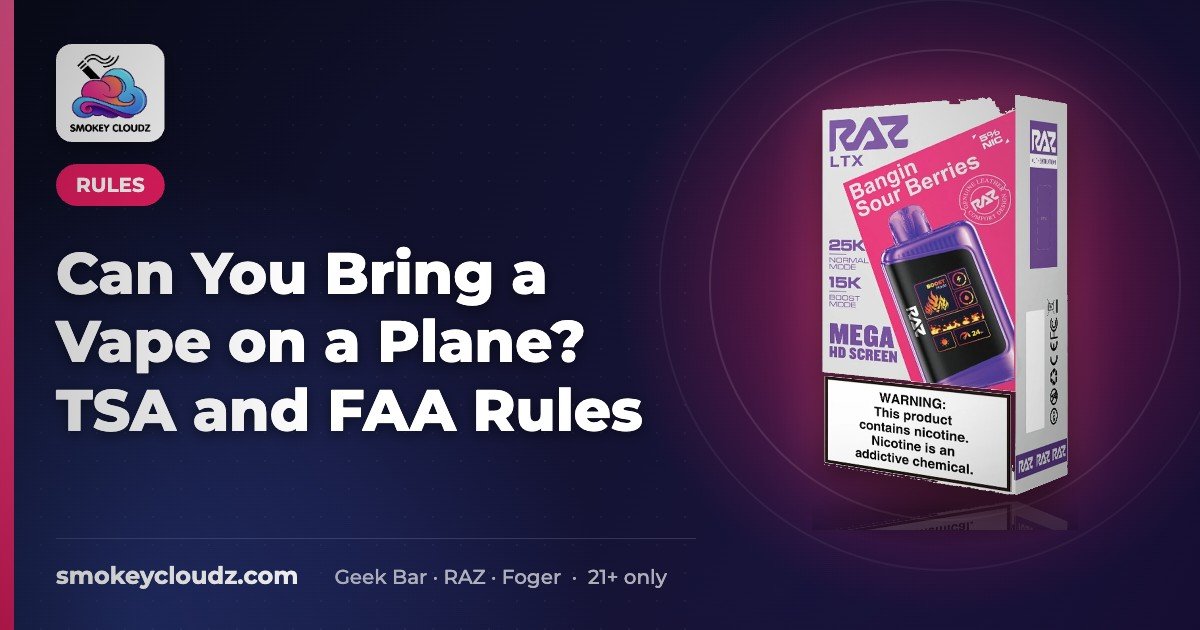
Can You Bring a Vape on a Plane? TSA and FAA Rules
Adults 21+: Yes — carry-on or on your person only, never checked bags (TSA + FAA). Pack so it cannot activate by accident; spare lithium batteries carry-on and short-circuit protected; do not use or recharge on board. Rules as of Oct 23, 2026. Not legal advice.

For adults 21+ only. Smokey Cloudz sells only to adults of legal age. See our Age Policy and Sales Restrictions. Vapes contain nicotine. Nicotine is an addictive chemical.
Quick answer: Yes — in the United States you can bring a vape on a plane in your carry-on bag or on your person. You may not put e-cigarettes or vaping devices in checked luggage. That is what the Transportation Security Administration (TSA) and the Federal Aviation Administration (FAA) say as of October 23, 2026. Pack the device so the heating element cannot turn on by accident, keep spare lithium batteries in carry-on and protected from short circuits, and do not use or recharge the device on the aircraft. Airlines can add their own limits — check yours before you fly. This page is a rules summary for adults 21+, not legal advice.
Carry-on yes, checked bag no
TSA’s What Can I Bring page for Electronic Cigarettes and Vaping Devices lists Carry On Bags: Yes (with special instructions) and Checked Bags: No. Electronic smoking devices are allowed only in carry-on baggage. TSA also notes that each lithium ion battery must not exceed a Watt-hour rating of 100 Wh, or for lithium metal batteries a lithium content of 2 grams, and that the final decision at the checkpoint rests with the TSA officer. (TSA page last updated March 29, 2023; facts cited as of October 23, 2026.)
FAA PackSafe for E-cigarettes and Vaping Devices matches that: devices must be carried on one’s person or in carry-on baggage — not in checked bags — under 49 CFR 175.10(a)(19). For the checked-bag angle in more depth, see what happens if you pack a vape in checked luggage. This post stays on the broad “on a plane†rules hub.
How to pack a disposable vape for a flight
Both TSA and FAA require effective measures so the heating element cannot activate by accident while you travel. FAA PackSafe lists examples such as removing the battery where the design allows, separating the battery from the heating coil, using a protective case or cover/latch on the activation button, or relying on built-in power-on protections. Keep the device in the cabin — carry-on or on your person — never in checked bags.
Stop it firing by accident
For sealed nicotine disposables (Geek Bar, RAZ, Foger, and similar), you usually cannot pull the cell out the way you can on some open systems. Use what the design allows: a hard case or sleeve, a cover over the button if your model has one, and packing so nothing holds the device on in the bag. Do not try to conceal the device from screening — follow TSA checkpoint instructions.
Spare batteries and pods
FAA PackSafe: spare lithium batteries must also be on your person or in carry-on, and each spare must be individually protected so terminals cannot short-circuit (retail packaging, tape on terminals, a battery case, or a snug protective pouch are examples the FAA lists). Recharging batteries or devices on board the aircraft is not permitted. Check with your airline for any limit on how many devices you may carry for personal use.
Can you vape on a plane? Can you charge it on board?
No to both under FAA guidance cited here. The FAA’s Vapes on a Plane? reminder (January 17, 2020) states that passengers should never use vaporizers or e-cigarettes on an aircraft — and that doing so is a federal offense. FAA PackSafe separately states that recharging these batteries and devices on board is not permitted. This guide does not list workarounds.
E-liquid and the 3-1-1 rule
If you travel with a bottle of e-liquid (not the sealed liquid already inside a disposable), treat that bottle as a liquid for TSA screening. TSA’s Liquids, Aerosols, and Gels Rule allows a quart-sized bag of liquids, aerosols, gels, creams, and pastes in carry-on, limited to travel-sized containers that are 3.4 ounces (100 milliliters) or less per item. Larger liquid containers belong in checked baggage under that liquids rule — but the device itself still cannot go in checked bags. (Liquids rule cited as of October 23, 2026.)
Airline and destination rules
TSA and FAA set the U.S. security and hazardous-materials baseline for the flight. Your airline may still limit how many devices you carry, and the place you land may restrict possession, flavors, or imports. Before you fly, read your carrier’s hazardous-materials page and the destination’s own law. Soft companions: flying with a vape to St. Croix and flavored vapes from the USA to Mexico. Those pages are informational — not legal advice. Rules change; verify official sources for your itinerary.
FAQ
Can you bring a disposable vape on a plane?
Yes for U.S. flights under the TSA/FAA rules summarized above: carry-on or on your person only, not checked bags, with accidental-activation measures and spare-battery protections. Adults 21+. Confirm your airline’s own limits.
Can you put a vape in checked luggage?
No for e-cigarettes and vaping devices under TSA What Can I Bring and FAA PackSafe as cited on this page (as of October 23, 2026). More detail: what happens if you pack a vape in checked luggage.
Can you vape in the airplane bathroom?
No. FAA states you should never use a vape or e-cigarette on an aircraft, and that doing so is a federal offense. Do not use the lavatory — or any other part of the aircraft — to vape.
Can you charge a vape on a plane?
No. FAA PackSafe states that recharging e-cigarette and vaping device batteries and devices on board the aircraft is not permitted. Pack spare lithium batteries in carry-on, each protected from short circuits.
Do I need to take my vape out at TSA?
Follow the officer’s instructions and the screening rules posted at your checkpoint. TSA’s device page says the final decision rests with the TSA officer. This site does not coach you to conceal items or skip screening steps.
What about a cruise or a stadium after I land?
Those venues use different rule sets. See vape rules on cruise ships and bringing a vape inside a stadium. Still adults 21+ only.
Sources
- TSA — Electronic Cigarettes and Vaping Devices (page last updated March 29, 2023)
- FAA PackSafe — E-cigarettes, Vaping Devices (page last updated April 13, 2026; 49 CFR 175.10(a)(19))
- FAA — Vapes on a Plane? (January 17, 2020)
- TSA — Liquids, Aerosols, and Gels Rule
Rules summarized as of October 23, 2026. Official pages can change after this date — trust the live .gov page for your trip. This article is for adults 21+ and is not legal advice.
Related guides
- What happens if you put a vape in checked luggage
- Can you bring a vape on a cruise ship
- Can you fly with a vape to St. Croix
- Can you bring a vape inside a stadium
- Shopping sealed nicotine options: disposable vapes · more in Vape Guides
Adults 21+ only. TSA/FAA facts as of October 23, 2026 — not legal advice. Eligible US sales only per our policies.