
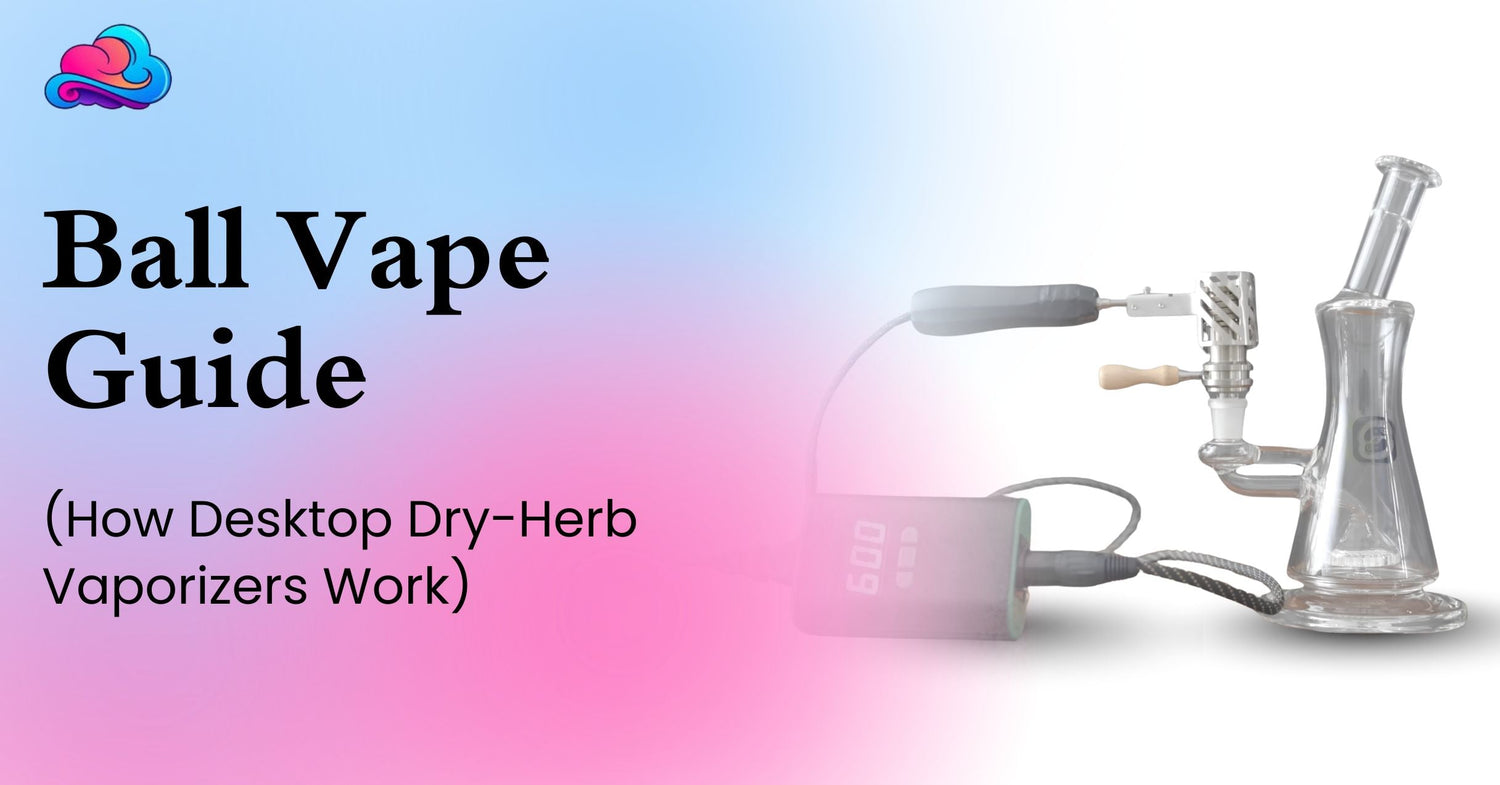
A desktop ball vape can look confusing when you first see the parts laid out on a table. There may be a heater head, a temperature controller, an electric coil, a bowl, cables, and small heat holding balls inside the head. Compared with a pocket size vape, it can look like a completely different category of equipment.
The basic idea is easier to understand once the parts are separated by job. A dry herb ball vape uses an electrically heated head containing small balls that store heat. Air moves through that heated area and becomes hot before it reaches the dry herb. This is why the system is commonly described as a type of convection vaporizer. Community explanations of these systems describe the balls as thermal mass that can hold heat while air passes through the head.
That design is very different from a disposable vape or replacement pod. For contrast, the Geek Bar Pulse 2 disposable vape is presented as a complete disposable electronic vaping product. A desktop dry herb setup has a different structure, different hardware, and a very different equipment layout.
This article is for adult readers. It focuses on device structure, parts, heat control, and buying checks rather than giving consumption instructions.
Ball Vaporizer Meaning?
A ball vaporizer is a desktop dry herb heating system built around a heater head that contains small heat holding balls. Those balls are heated by an electric heating element, while a controller manages the heater temperature.
The purpose of the balls is heat storage. Community explanations describe them as adding thermal mass inside the heater. Once they become hot, they can keep supplying heat to air passing through the head instead of depending only on a bare heating element.
This puts the device in a very different category from pod based nicotine products. The CLIO Platinum replacement pod, for example, is a prefilled pod made for its related device system. It does not use the desktop heater arrangement discussed here.
Understanding the category first prevents a lot of confusion later. A person searching dry herb desktop hardware should not compare it directly with disposable or prefilled pod products just because all of them may be called vaporizers in casual conversation.
Heated Balls and Heat Storage?
The small balls inside a ball vape heater are there to hold heat. They sit inside the heater head and create a larger heated area for incoming air to pass around.
A community explanation describes ceramic, glass, gemstone, and similar small balls being used in different designs. The exact material and size can vary between systems, so those details should come from the maker of the specific unit rather than from a general description.
This heat holding role is the key reason the design differs from some other dry herb devices. A convection vaporizer works by sending heated air through the material rather than depending only on direct contact with a hot surface.
The balls themselves are not a power source. They need the heater assembly to bring them up to the controlled temperature set by the system. That relationship between heater, balls, airflow, and controller is at the center of the design.
Required Parts for a Desktop Setup?
A desktop ball vape generally involves several connected parts. Community descriptions commonly mention a heater head containing the balls, an electric coil around or connected to the head, a temperature controller, and a bowl used with the heating setup. Some setups are also paired with compatible glass hardware.
The temperature controller is often called a PID controller in community discussions. Its job is to monitor the heating system and adjust power so the heater stays near its set point as conditions change.
The electric coil provides heat to the head. The heated head then transfers thermal energy into the balls. Air passing through that heated section picks up heat before continuing through the system.
Those parts need to belong to a compatible setup. Similar looking controllers, coils, plugs, or heater heads should not be mixed only because they physically appear close in size. Community discussion specifically notes that coil shape, dimensions, and electrical pin arrangements can vary.
Convection Vaporizer Airflow Basics?
A convection vaporizer relies heavily on moving hot air. In this style of system, the heated air is a major part of the vaporization process.
The small balls increase the amount of hot material inside the heater head. Air passes through or around this heated mass, picking up energy before moving farther through the device.
This is also why airflow is frequently discussed around this type of hardware. The heater cannot be understood only by looking at its temperature display. The path taken by air through the heated section is part of the design.
A dry herb ball vape therefore combines temperature control with an open air path through the heated head. The exact airflow arrangement can differ by model, which is another reason product specific instructions matter.
Temperature Controller and Heater Relationship?
The controller and ball vape heater work as a pair. The controller manages electrical power while the heater head stores and transfers heat.
Community users often refer to the controller as a PID. In basic terms, it watches the heater temperature and changes the power supplied to keep the system close to its selected setting.
That sounds technical at first, and it is understandable if the terminology feels heavy. You do not need to treat every acronym as a separate mystery. Think of the controller as the part managing heat and the heater head as the part holding and delivering that heat.
The important buying point is compatibility. Controller, coil, and heater specifications need to match the intended system. A connection fitting into a socket is not enough evidence that 2 electrical components belong together.
Desktop Hardware Versus Pod Systems
A desktop ball vape normally stays in a fixed setup because it depends on external electrical hardware and several connected components. That makes it very different from small pod products designed around portable battery sections.
The RAZ Vue 50K replacement pod gives a clear contrast. It is a prefilled replacement component for the related Vue system rather than a desktop heater built around thermal balls, a coil, and a temperature controller.
This distinction matters when reading product descriptions online. A pod, disposable device, portable vaporizer, and desktop heater can all appear under broad vaping language while serving very different product roles.
The right comparison starts with category. After that, compare the parts required for the exact type of device you are reviewing.
A 5 Point Hardware Check
Before comparing a ball vaporizer, put the required hardware into 5 groups. First comes the heater head. This is the section holding the heated media.
Second comes the heating element or coil. It needs to be designed for the heater system being considered. Third comes the controller, which regulates the heat supplied to the coil.
Fourth is the bowl or compatible receiving section used with the setup. Fifth is any additional glass or supporting hardware specified for that system.
This is not a build guide. It is a product comparison method. The goal is to confirm that a complete system actually includes or supports all required parts before money is spent.
That same buying habit is useful with discount pages too. A coupon means very little when the discounted item is not the part you actually need. The Element Vape coupon code buyer checklist gives broader context for checking terms, product details, and checkout conditions before treating a discount as the main reason to buy.
Real World Example: The Missing Controller Problem
Picture an adult shopper seeing a dry herb heater head listed online. The photo looks like the main part of the device, so the shopper assumes the listing contains everything needed for the full desktop system.
After reading the product details more carefully, it becomes clear that the heater is only one part of a larger arrangement. A controller, compatible coil, bowl, or other required hardware may be separate depending on the exact product.
This kind of misunderstanding is easy to have because a heater head can look like the most important part. Yet a ball vaporizer is a system, not just a single metal or ceramic component.
The better comparison is based on the full package contents. Write down every required piece, then check which ones are included and which ones must already be owned.
Portable Vape Expectations Can Cause Confusion
People familiar with pocket devices may expect every vape to be easy to carry. Desktop dry herb hardware breaks that expectation because several parts can depend on mains power and a fixed setup.
Travel is therefore a separate topic. The vape rules for air travel cover airline and battery restrictions for vape products generally. Those rules should be checked separately rather than assuming desktop equipment follows the same handling pattern as a small disposable.
A dry herb ball vape should be viewed first as desktop equipment. Portability should only be claimed when the exact product information supports it.
This keeps expectations realistic and prevents desktop hardware from being compared with pocket devices on size alone.
Price Needs the Full Equipment List
A low price can look attractive until required components are added. This matters with desktop systems because a listing may represent a heater, controller, bowl, or full kit rather than the same package every time.
Retail setting also affects comparison. The Alto vape gas station price guide deals with a very different product category, but its broader buying lesson still applies: compare the exact item and package rather than treating store location or a single price number as the full story.
For desktop dry herb hardware, record the exact components included in the listing before comparing prices. A heater only listing and a complete desktop package are not equal purchases.
A good comparison also avoids assuming that higher cost means a technically better match. Compatibility comes first.
Issues That Often Create Problems
One issue is thinking the heated balls are the heating element. They store and transfer heat, while the powered heater system brings the head and balls to temperature.
Another issue is treating every controller and coil as interchangeable. Community discussion around these devices points out that electrical pin layouts, coil size, and coil shape can differ.
A third issue is buying only the heater head and later realizing that the rest of the system is separate. Read package contents carefully before assuming a listing represents a full setup.
Another problem is comparing this equipment with disposable products based only on puff style or vapor production. The device architecture is different, so those comparisons can hide more useful questions about parts, power, and compatibility.
Practical Tips for Better Hardware Checks
Keep a written list of the required components for the exact system. Mark each item as included, already owned, or still required. This can make a complicated product page much easier to follow.
Check the controller and coil as a matched pair rather than as 2 unrelated accessories. If electrical specifications or pin information are unclear, use documentation tied to that exact system instead of guessing.
Treat the ball vape heater as very hot electrical hardware. Its placement, stand, cables, and surrounding area deserve attention whenever it is powered. Avoid improvised supports or loose arrangements that are not part of the intended setup.
Finally, compare product category before price. A dry herb desktop system, nicotine disposable, and replacement pod should never be placed in the same price comparison as if they offer the same hardware.
Community Discussion Adds Useful Context
The terminology around this category can overwhelm people. A supplied Reddit discussion about understanding desktop dry herb ball systems shows exactly that. Users in the thread repeatedly reduce the concept to 3 ideas: a heated head contains small balls, the balls hold heat, and a controller plus coil manages that heat.
The discussion also shows that community members disagree on products, prices, and personal preferences. That makes Reddit useful for seeing the questions real users struggle with, but it should not replace specifications from the maker of a particular device.
For technical compatibility, use the exact documentation for the heater, coil, controller, and other parts in the system.
That separation between community experience and product specifications is important when electrical hardware and very hot surfaces are involved.
The Bigger Dry Herb Device Strategy
A dry herb ball vape is only one category within the wider vaporizer market. Other designs can use different heating structures, power sources, sizes, and control methods.
This article belongs naturally inside a complete dry herb vaporizer guide. That wider pillar can compare desktop units, portable formats, heating styles, required hardware, and maintenance topics while this page stays focused on the ball based desktop design.
Understanding the category first makes later product comparisons much clearer. Instead of seeing a pile of unfamiliar components, the reader can separate the heater, heat storage media, controller, airflow path, and supporting hardware by purpose.
That wider context also prevents unrelated pod and disposable systems from being mixed into a dry herb hardware decision.
When More Product Support Makes Sense
Support is worth considering when the listing does not clearly state whether the controller, coil, heater head, bowl, or other required components are included.
It also matters when a person already owns a controller or coil and wants to know whether it matches another heater. Electrical connection, pin layout, coil shape, and system specifications need confirmation rather than guesswork.
If the heater, cable, controller, or connector appears damaged, do not try to modify the electrical parts to make them fit. Use the product documentation or seller support tied to the exact model.
Desktop systems can look intimidating because there are more visible parts. Clear component information is the best way to reduce that uncertainty.
Conclusion
A convection vaporizer in this desktop category uses heated air as a major part of its operation. Small balls inside the heater increase the heated mass, while an electrical coil and controller manage the heat supplied to the head.
The device should be understood as a complete hardware system rather than a single heater. Heater head, heating element, controller, bowl, and any required supporting hardware all need to belong to the intended setup.
For an adult comparing desktop dry herb products, start with the complete parts list. Then check compatibility, package contents, electrical requirements, and manufacturer information before comparing price.
That approach removes much of the confusion around this unusual looking vaporizer category.
FAQs
Ball Vaporizer Basic Meaning?
A ball vaporizer is a desktop dry herb heating system with small heat holding balls inside its heater head. A powered coil and controller manage heat for the system.
Heated Balls Main Purpose?
The balls add thermal mass. They absorb and hold heat so incoming air can move through a hot area before reaching the dry herb.
Regular Dry Herb Vaporizer and This System: Same Thing?
They belong to the wider dry herb vaporizer category, but the hardware can be very different. This desktop design uses a heater head containing heat holding balls plus external control hardware.
Convection Vaporizer Meaning in This Setup?
A convection vaporizer uses heated air as an important part of the heating process. Air receives heat as it passes through the heated head.
Controller Required?
Community descriptions of these desktop systems commonly include a temperature controller and electric coil. The exact required parts depend on the specific product.
Heater Head Alone a Complete Setup?
Not necessarily. A listing may cover only a heater head or another individual part. Check package contents for the controller, coil, bowl, and any other required hardware.
Every Coil Compatible With Every Controller?
No such assumption should be made. Electrical connections, pin layouts, dimensions, and heater designs can differ between systems.
Desktop Unit Intended as a Pocket Device?
This category is generally discussed as desktop hardware using external electrical components. Check the exact product specifications for its intended placement and power requirements.
Community Advice Enough for Compatibility?
No. Community discussion can clarify basic ideas, but exact heater, controller, and coil compatibility should come from documentation for the specific system.


Leave a comment
This site is protected by hCaptcha and the hCaptcha Privacy Policy and Terms of Service apply.